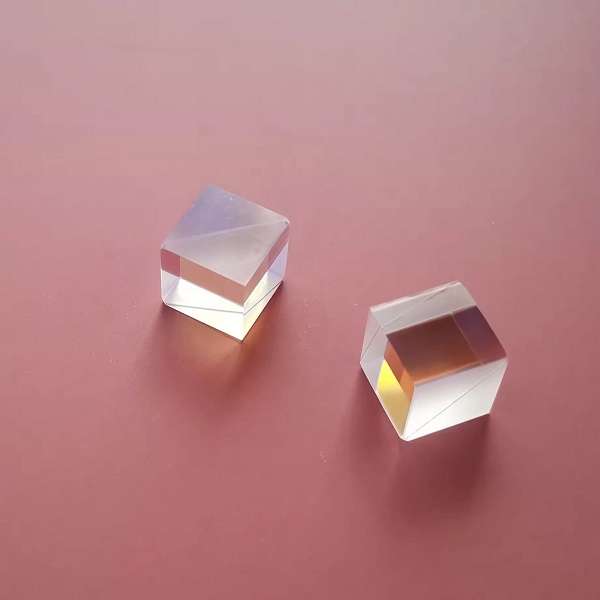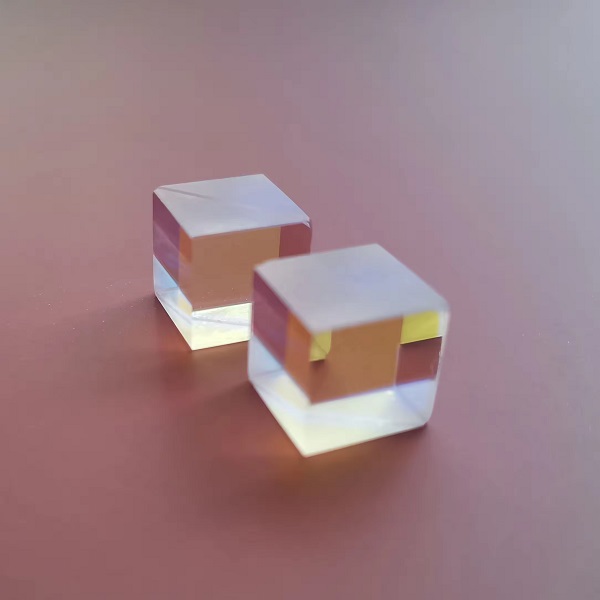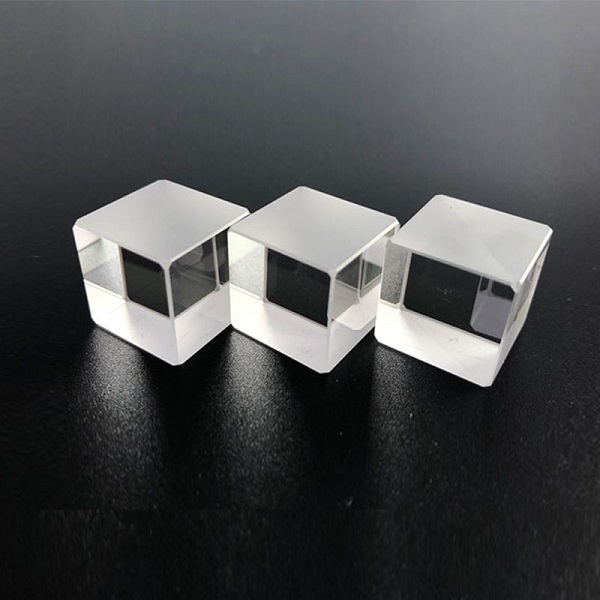
Products
Material: BK7
Surface Quality: 60/40
Angle Tolerance: 3secs - 3 mins
S/D: 60/40 - 40/20
Dimensional tol: ±0.1mm
Angle tol: less than 3 min
Flatness: L/2 - L/10
R/T data: 10/90, 20/80, 30/70, 40/60, 50/50, 60/40,70/30, 80/20
Coating type: splitting and AR coating
Wavelength: VIS
Application: splitting light
BK7(K9) is one of the most commonly used optical glasses and is widely used in the manufacture of spectroscopic prisms (PBS/NPBS) due to its excellent cost performance, wide band transmittance and good processability.
What are the advantages of BK7 (K9) beamsplitters?
(1) Wide band applicability
Suitable for visible (VIS) to near infrared (NIR) (350-2000 nm), ideal for most general purpose optical systems. Transmittance >90% in the 400-700 nm (visible) range (up to 99% with permeation enhancement coating).
(2) Low dispersion (high Abbe number)
Low dispersion, suitable for white light or broadband light source (such as LED, halogen lamps) to reduce the impact of color difference.
(3) Low cost, easy processing
Compared with fused silica, CaF₂ and other materials, BK7 is inexpensive and suitable for mass production. It is easy to cut, polish and coat, and has a high processing yield.
(4) Mechanical and environmental stability
Resistant to moisture, acid and alkali corrosion, suitable for general laboratory and industrial environments. Lower coefficient of thermal expansion, less influence of temperature change (but still not as good as fused silica).
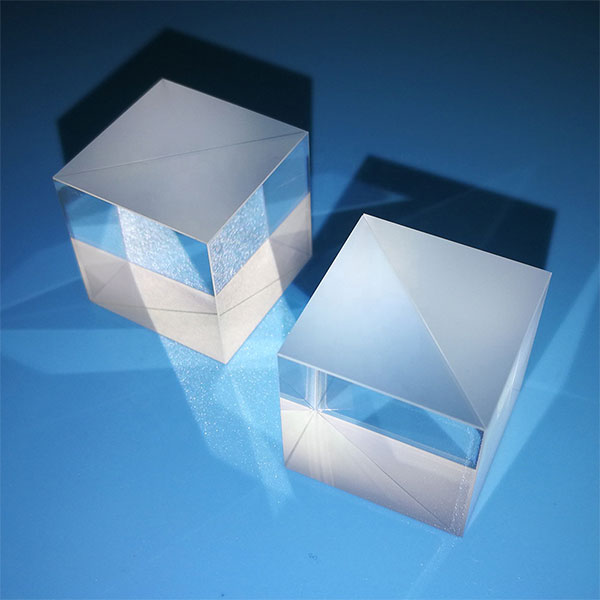
Beamsplitter Prism is constructed by cementing two right angle prisms, Standard Cube Beamsplitters offer a range of reflection/transmission ratios.