
Products

The double convex lens, a seemingly fundamental component in the world of optics, is often the critical element that determines the performance of high-end precision instruments. From capturing the first silver plate photographs of the moon in the 19th century to playing an indispensable role in advanced photolithography machines and laser fusion devices today, its importance cannot be overstated. However, many engineers in the selection process only understand its basic characteristic of “converging light,” overlooking the profound optical principles and technical nuances behind it. This can lead to suboptimal system performance.
This article delves into the physical essence of the double convex lens, offering insights from professional perspectives such as spherical aberration, coma, and conjugate ratio. Our goal is to guide you in selecting the most appropriate “eye of convergence” for your optical system.

A double convex lens, also known as a biconvex lens, is an optical element consisting of two outwardly curved spherical surfaces. Typically, both surfaces have an equal radius of curvature. Geometrically, it is characterized by being thicker at the center than at the edges. This symmetrical structure grants it unique optical properties: a positive focal length, meaning it can converge parallel light rays (or light from a point source) to a real focal point.
The core function of a double convex lens is to converge light. When a beam of parallel light rays, traveling parallel to the optical axis, enters a double convex lens, the rays bend inward as they refract through both spherical surfaces. They eventually converge at a point on the optical axis known as the focal point. This characteristic makes it a fundamental component in imaging systems and energy concentration applications.
The focal length of a double convex lens isn’t arbitrary; it strictly follows the Lensmaker’s equation: 1/f = (n-1)(1/R₁ - 1/R₂). For a double convex lens with equal radii (R₁ = -R₂), the formula simplifies to 1/f = (n-1)(2/R), where ‘n’ is the refractive index of the lens material, and ‘R’ is the radius of curvature of the spherical surfaces. Furthermore, the principal planes (the virtual planes where the light rays appear to bend) of a double convex lens shift towards the center of the lens as the center thickness increases. This is a crucial consideration during precise optical path design.
Among various lens types (like plano-convex or meniscus lenses), why opt for a double convex lens? Its primary advantage lies in minimizing aberrations through symmetry.
When the object distance and image distance in an optical system are equal (i.e., a magnification of 1:1) or very close, the double convex lens is unequivocally the best choice. Due to its perfect geometric symmetry, the path of light rays through the lens is also symmetric. This symmetry remarkably and automatically cancels out several geometric aberrations, including spherical aberration, coma, and distortion. This means that in a 1:1 imaging system, a double convex lens provides the sharpest, most distortion-free image quality.
While a 1:1 conjugate ratio is its ideal operating point, the double convex lens is not limited to it. It performs admirably across a range of conjugate ratios (object distance/image distance) from 5:1 to 1:5, effectively controlling aberrations. Within this range, its symmetric structure still effectively balances the refraction of rays on both sides of the lens, resulting in better image quality compared to asymmetric lenses.
Beyond imaging, double convex lenses are highly effective at concentrating energy. Whether it’s focusing light from a point source or efficiently coupling a beam of light into an optical fiber or the next stage of an optical system, their symmetric dual-surface design minimizes light energy loss.
This is a common dilemma for engineers. Although both are positive lenses capable of converging light, their ideal applications are distinctly different. Choosing the wrong lens, even with the correct focal length, can lead to significant system aberrations.
Plano-Convex Lens: Its optimal application is for infinite conjugate ratios. This means either a beam of parallel light (originating from infinity) needs to be focused, or a point source needs to be collimated into parallel light. In this scenario, orienting the convex side towards the infinite light source minimizes spherical aberration.
Double Convex Lens: It is specifically designed for finite conjugate ratios. When both the object and image are at finite distances, and these distances are relatively close (within a ratio of 5:1), the double convex lens is the optimal solution.
The Golden Rule for Selection:
The application fields of double convex lenses are incredibly broad. They exist not only in textbook optical diagrams but are also active components in almost all modern technology involving light.
In laser cutting, welding, and marking machines, double convex lenses are commonly used in beam expanders or focusing systems. Specifically, double convex lenses made from materials like Zinc Selenide (ZnSe) are standard for focusing high-power CO₂ laser beams operating at the 10.6μm wavelength.
Selecting a double convex lens involves more than just looking at “diameter” and “focal length.” The following key parameters directly determine the lens’s performance in your specific application.
Uncoated optical glass surfaces have a reflection loss of approximately 4% per surface. Applying coatings is essential for increasing transmission and eliminating stray light.
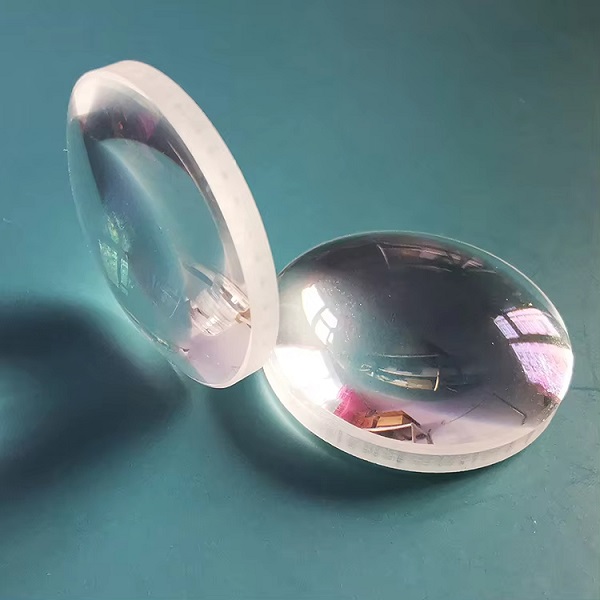
The double convex lens, seemingly a simple piece of glass, is truly a testament to the ingenuity of precision optics. It is more than just a tool to focus sunlight and ignite a flame; it serves as a bridge connecting the microscopic and macroscopic worlds. Every detail, from selecting the correct material and coating to understanding its irreplaceable role in 1:1 imaging, determines the ultimate success of your optical system.
The next time you are tasked with designing an optical system with a finite conjugate ratio, remember the perfectly symmetrical double convex lens—it may very well be the answer you’ve been searching for. If you have specific requirements for double convex lenses tailored to a particular wavelength, power level, or precision tolerance, please feel free to contact our optical engineering team for professional selection advice and design solutions.