Home » The Ultimate Guide to Calcium Fluoride Lenses: From UV Lithography to Mid-Infrared Systems
The Ultimate Guide to Calcium Fluoride Lenses: From UV Lithography to Mid-Infrared Systems
In the realm of precision optics, the choice of material often dictates the performance boundaries of an entire system. When your application needs to span from the deep ultraviolet to the mid-infrared, when you are battling thermal lensing effects in high-power laser systems, or when you are struggling to correct chromatic aberrations in multispectral imaging, a Calcium Fluoride Lens (CaF₂) might be the overlooked “optimal solution.”
This seemingly traditional crystalline material, leveraging its unique transmission bands and physical properties, remains an irreplaceable core component in modern high-end optical systems. This article delves into the technical parameters, selection criteria, and typical applications of calcium fluoride lenses, aiming to help optical engineers and procurement decision-makers better utilize this premium material.
1. Why is Calcium Fluoride Still Irreplaceable in Modern Optics?
Calcium fluoride (CaF₂), known in its natural mineral form as “fluorite,” possesses fundamentally different physical and optical properties compared to common optical glasses like N-BK7 or fused silica.
1.1 Ultra-Wide Transmission Range: A Versatile Performer from UV to IR
Standard optical glasses struggle in the ultraviolet (< 300 nm) and deep infrared (> 3 μm) regions due to intrinsic absorption. In contrast, calcium fluoride crystals boast an exceptionally wide transmission range, spanning from approximately 0.13 μm to 10 μm.
Deep UV Performance: In 193nm excimer laser lithography systems, calcium fluoride lenses are one of the few materials capable of withstanding high-energy photon bombardment without forming color centers (exhibiting high radiation resistance) .
IR Performance: Its high transmittance extends to the 8-10 μm band, making it widely used in Fourier Transform Infrared Spectroscopy (FTIR) and thermal imaging systems .
1.2 Extremely Low Refractive Index and Dispersion
Calcium fluoride has a refractive index of around 1.43 in the visible spectrum, significantly lower than N-BK7’s 1.52. More importantly, it possesses an exceptionally high Abbe number (approximately 95), indicating extremely low dispersion .
Apochromatic Correction: In high-end microscope objectives and long-focal-length lenses, calcium fluoride is often paired with high-index glasses (like lanthanum crown glass, LaK) to correct secondary spectrum and achieve “apochromatic” performance.
1.3 High Laser-Induced Damage Threshold
For high-power laser systems, impurities in ordinary glass can absorb energy and lead to thermal fracture. Calcium fluoride not only has a low thermal expansion coefficient but also a negative thermo-optic coefficient (dn/dT). This can partially compensate for thermal lensing effects under high power. Combined with its high damage threshold, this makes it ideal for excimer and CO₂ laser systems .
2. In-Depth Analysis: Key Performance Specifications for CaF₂ Lenses
During procurement or design selection, knowing it’s “calcium fluoride” is not enough. You need to focus on the following key technical specifications, as they directly determine the lens’s performance in your actual system.
2.1 Material Grade: UV Grade vs. IR Grade
Not all calcium fluoride is created equal. Based on the raw material source and growth process, it’s primarily classified into two grades:
UV Grade: Synthesized from high-purity chemical precursors, this grade exhibits virtually no absorption bands in the deep UV region below 200nm. It is suitable for applications like 193nm lithography and UV solar-blind detection systems .
IR Grade: Typically produced from purified natural fluorite or standard polycrystalline materials, this grade is more cost-effective. It performs excellently in the 3-5 μm infrared band but may show impurity absorption peaks in the UV region .
2.2 Surface Quality and Precision
Calcium fluoride is relatively soft (Mohs hardness ~4, significantly lower than fused silica), requiring special attention during manufacturing and inspection.
Surface Quality (Scratch-Dig): For excimer laser applications, extremely high surface quality (e.g., 10-5 or 20-10) is typically required to prevent surface defects from triggering ionization and damage under intense laser light. For general infrared applications, 40-20 or 60-40 standards are common .
Surface Figure (PV Value): High-precision imaging or interferometric systems often demand surface accuracy down to λ/10 or better, while λ/4 suffices for more general applications .
2.3 Coatings: The Crucial Role of Anti-Reflective Films
While uncoated calcium fluoride offers decent transmission, it still suffers from approximately 5.4% reflection loss per surface. Applying coatings is key to unlocking its full potential.
UV AR Coatings: Designed for specific wavelengths like 193nm or 355nm, these coatings significantly increase transmission and extend lens lifetime.
IR AR Coatings: Optimized for bands like 3-5 μm or 2-5 μm, these are standard for thermal imaging and infrared laser systems (e.g., IR1 coating for the 3-5 μm band) .
3. Typical Applications and Matching Selection for CaF₂ Lenses
Different applications prioritize different aspects of calcium fluoride lenses. The following case studies illustrate how to choose the right lens for your project.
3.1 Spectroscopic Analysis and Scientific Research
In research, particularly time-resolved fluorescence or Raman spectroscopy, calcium fluoride’s low fluorescence background is a critical advantage.
Use Case: In gas analysis or FTIR systems, CaF₂ windows and lenses, due to their wide transmission, ensure that characteristic peaks from the near-IR to mid-IR are not masked or absorbed by the material itself .
Selection Advice: For broadband measurements covering UV to IR, it is recommended to use uncoated or custom broadband-coated UV-grade CaF₂ lenses to avoid ripple effects or absorption introduced by standard coatings.
3.2 High-Power Laser Processing (Excimer Lasers)
In semiconductor lithography and laser micromachining equipment, 193nm or 248nm excimer lasers possess extremely high photon energy.
Challenge: Ordinary glass rapidly develops color centers (darkening) under UV exposure, leading to significant energy loss.
Solution: CaF₂ lenses not only resist UV damage but their negative dn/dT helps counteract focus shifts caused by thermal absorption. For such applications, 193nm lithography-grade calcium fluoride material is mandatory, often requiring a laser damage threshold test report .
3.3 Infrared Thermal Imaging and Infrared Guidance
In the mid-wave infrared (MWIR, 3-5 μm) band, calcium fluoride is an excellent infrared material.
Use Case: Infrared optical systems often need to maintain image quality over a wide temperature range. Calcium fluoride has a stable thermo-optic coefficient and is frequently paired with materials like Zinc Sulfide (ZnS) or Zinc Selenide (ZnSe) for aberration correction.
Selection Advice: For IR applications, sometimes the more cost-effective polycrystalline CaF₂ can be used. It is essential to apply high-efficiency AR coatings specifically designed for the 3-5 μm band to maximize system throughput .
4. Practical Guide: How to Properly Use and Maintain CaF₂ Lenses?
Many engineers have mixed feelings about CaF₂ lenses, often due to concerns about their physical and chemical stability. However, with proper handling techniques, CaF₂’s durability is sufficient for demanding applications.
4.1 Understanding “Hygroscopic” Behavior
There’s a historical notion that CaF₂ is “moisture-sensitive,” but this is somewhat misunderstood.
Reality: Calcium fluoride has extremely low solubility in water (only 0.0017g/100g water at 20°C). In fact, it is not prone to deliquescence like KBr or NaCl .
Precaution: While not easily hygroscopic, it is sensitive to acidic or alkaline environments. Prolonged storage in extremely hot and humid conditions (e.g., >40°C, >65% RH) might cause slight surface hydrolysis. It’s advisable to store CaF₂ optics in a desiccator. If used in harsh environments, simply clean and dry them promptly afterwards .
4.2 Cleaning and Mounting: Handle Soft Materials with Care
With a Knoop hardness around 158, CaF₂ is harder than materials like Barium Fluoride but still softer than typical optical glasses.
Cleaning: The recommended method is “blow first, wipe second.” Use a rubber bulb or air blower to remove dust particles (hard particles are the primary cause of scratches). If residues remain, use lens tissue soaked in spectroscopic-grade acetone or ethanol, wiping gently in a single direction. Avoid applying heavy pressure or rubbing back and forth dry .
Mounting: When securing the lens in a cell, avoid excessive pressure or using sharp set screws directly against the element. Use nylon-tipped set screws or spring-loaded retaining rings to prevent stress-induced deformation or edge chipping .
5. Customization Services: When Standard Catalogs Don’t Suffice
While standard diameters (e.g., 25.4mm, 50.8mm) and focal lengths are available off-the-shelf , customization is often necessary for cutting-edge research or specialized equipment.
5.1 Customization Dimensions: Beyond Just Size
Crystal Orientation: For applications requiring minimal birefringence (e.g., nonlinear optics), the crystal growth axis (e.g., [111] orientation) can be specified .
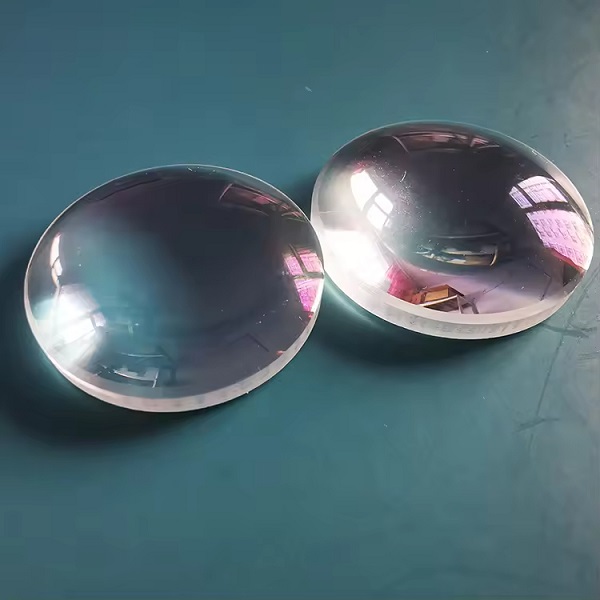
Special Surface Profiles: Beyond standard plano-convex or bi-convex shapes, CaF₂ can be fabricated into meniscus or even aspheric lenses for specific wavefront shaping needs, although fabrication complexity and cost will increase .
5.2 Information Needed for an Inquiry
To receive accurate quotes and product suggestions, it’s best to provide suppliers (like JCOPTIX, United Optics, etc.) with the following clear information:
Diameter/Size and Tolerance (e.g., 25.4 +0.0/-0.1 mm).
Effective Focal Length / Radius of Curvature.
Material Grade (UV Grade / IR Grade).
Coating Requirements (Specify wavelength band and desired transmission).
Surface Quality / Damage Threshold Requirements (Crucial for laser applications).
Conclusion: Precise Material Selection for Winning Optical Designs
The calcium fluoride lens, as a classic and high-performance optical component, plays an irreplaceable role in UV lithography, infrared imaging, and high-energy laser systems. Understanding its material properties and mastering the correct selection and handling methods can not only optimize the final performance of your optical system but also effectively control project costs and risks.
If you are planning a new optical system or have questions about your current use of calcium fluoride lenses, please contact our technical team for professional support. We can recommend the most suitable calcium fluoride lens solution based on your specific wavelength band, energy threshold, and operating environment.